?
?
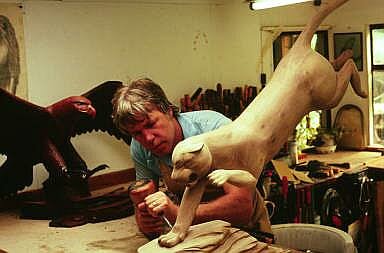
A quite remarkable true story about?Ian G Brennan's determination?in 1984 to recover?from losing his furniture making business in a?fire. To?then discovering?to his amazement that he had?a natural but dormant ability to be a sculptor?and within five years of the fire was appointed the Sculptor to the Most Noble Order of the Garter and Honourable Order of the Bath Subsequently since that time?has been commissioned to create?over eighty?five unique sculptures for such dignitaries as?Heads of State, Nobility and both?British and European Royalty.
Ian is one of those rather rare sculptors that both carves and casts, his?highly detailed?realistic and heraldic wood carvings and bronze sculptures can?be now be found in Windsor Castle, Westminster Abbey, Museums, Government Buildings, Churches, Company receptions and?private art collections all over the World. During the past five years Ian's one man exhibitions of his work have been?almost exclusively?set in the somewhat?formal?surroundings?of Museums; The Queens Room onboard?Cunards QE2;? Burlington House, Home of the Royal Academy?of Arts?and within?the magnificent historic setting of St George's Chapel in Windsor Castle.?
?
?
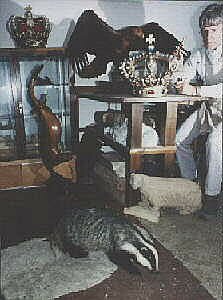
A small selection?of the?variety of wood carvings and bronze?sculpture?by Ian?G Brennan?on exhibition?in?St George's Chapel in Windsor Castle
?
Phoenix from the Ashes
?
?
What a difference a decade can make; after ten years of ?hard work?Ian?Brennan?had built up his own successful furniture?making furniture, however?with a?full order book, plans to expand?and about to take on?new staff?this was?all to dramatically change when his workshop and the contents were?destroyed in a fire. Worst was to follow when Ian later discovered there was a problem with his insurance cover which meant he was uninsured and had lost everything in the fire.
This problem?with?the insurance?proved to be?just?the start of Ian's?troubles, although his?customers who's orders were lost in the fire were very?understanding and?were prepared to wait for their? furniture and new kitchen orders to be replaced,?his Bank who he?had an account with?for nine years were not.? Ian's?first task?was?now to try and find a?new Bank who would?consider taking?over his overdraft facility and?also?give him?a bit of a?breathing space?to enable him to stay in business.?Without any assistance from his own bank?he obviously could now no longer afford to replace his tools and equipment, pay his bills let alone?now try and find the rent?for?the?new workshop.?He simply had no choice but to?clear himself a space amongst?the rubble, borrow some electricity from a friends?adjoining workshop, replace the burnt out telephone, hire some tools and start again.
It was then when Ian was about?to discovered to?his?complete surprise,?that it would appear he?had?a?dormant, natural ability?to be?a?sculptor which culminated in?within five years?from the fire?which destroyed his?business, Ian was?appointed the 'Sculptor to the Most Noble Order of the Garter and Honourable Order of the Bath'. Since this appointment,?in 1989 sculptor Ian G Brennan has received to date over 85 commissions from the?Royal Household. As well as commissions for the British Royal Family the latest being?two sculptures for HM the Queens sons, HRH Prince Andrew and HRH Prince Edward, there have also? been various commissions for other Foreign Royal Families, included HM King Juan Carlos of Spain , HM Queen Beatrix of the Netherlands , HM King Harald V of Norway and His Imperial Majesty Emperor Akahito of Japan .
?
?
?
At?4.47am on the?7th May 1984,?Ian G Brennan was awoken?just before dawn by a loud banging on his front door. A police officer?had come to tell him that his business had been?totally destroyed in?a fire and could he meet with him as soon as possible at the workshop. When he arrived at his workshop shortly afterwards which was just a few miles from his home?there were two fire engines an ambulance and the police office in his car, parked near to where his workshop once used to be.
The whole building had been burnt completely to the ground, although his?heavy woodworking machines were still there they had?partially melted in the intense heat and?were still glowing red hot in the dawns early?light. The?large caravan which had been parked alongside?Ian's workshop for many years?which had?been used by the all the small businesses near his workshop as a rest room, someone was believed to?have left on the electric fire?over night which?subsequently had?set fire to his and an adjoining workshop.
All his completed furniture,?designs and templates, machinery,?tools,? prepared timber and a completed solid oak kitchen awaiting delivery had all been destroyed in the fire. Worst was to come, as he?was later to discover?there was now a problem with his insurance?cover for the workshop, which meant he was uninsured and had lost everything in the fire.?Ironically as it turned out the new workshop Ian was planning to move?into?just four days later?was fully insured but empty.? ???????????????????????????????????????????????????????????????????????????????????????????????????????
The remains of?the fire damaged workshop
?please click to enlarge
Some of the?furniture Ian had been working on just before?the fire?had fortunately been ?removed earlier from his?workshop?and delivered to the customer. These? included?the?majority of the solid mahogany units Ian?had built for the Galley of the J Class Yacht?? 'Velsheda'?which was shortly?to take part?in the Tall Ships race, although?unfortunately some of these?mahogany units for the Velsheda?were?still in the workshop awaiting delivery and were consequently destroyed?in the fire.?Several weeks earlier Ian had?decided to removed?the two huge cedar logs?that he had been seasoning inside the workshop outside, to give him a bit more room so he could not?only set out the Velsheda's galley but?also the?solid oak kitchen?he had also been?working on.
These?hundreds of square feet of high quality cedar wood?timber were fortunately now seasoned and safely stored away, as it turned out far enough from the workshop and were?undamaged in the fire, although a little charred on the edges. He at least?still had?a supply of timber to use for many?of his projects, even if he now no longer had?the tools, woodworking machinery or most importantly a?workshop to put it all in.??
?
Part of the?mahogany units Ian had built for the galley of the J Class Yacht Velsheda?
?
"During the early afternoon on the?day of the fire, the remains of the workshop?had cooled down sufficiently enough so we could?start scouring through?the debris on the floor of the workshop trying to salvage anything of value?that I could either use or be sold?as scrap metal. I?then noticed to my amazement although?many of my?tools and heavy metal woodworking?machinery had melted or were bent and twisted in the intense heat?of the fire, a small section of a the remains of a wooden roof beam?although charred on the outside had strangely burnt to a rough shape which?resembling?a leaping dolphin, after showing my wife the unusual? piece of burnt?wood, I put it to one side for a moment and continued to search through the rubble."??
When Ian eventually got home one of the first things he tried to do?was to?contact?as many of his customers he could to inform them of his current difficulties and that unfortunately there would?now be?a delay in re-making?their orders. He managed to contact all except?one of?these customers?who?with out exceptions were very?sympathetic and?just as?importantly?were willing to wait for their furniture orders to be rebuilt.??"After contacting the customers and subsequently securing these?orders?knowing I?still have work and potential money coming in. I made an?appointment?with my bank manager?who I had fortunately had a good working relations with for?many years. I?was not asking to borrow?a lot more money, I was just hopping for?enough to enable me to hire some tools and materials for a few weeks and?also?if possible?perhaps for the?bank to honour my?standing orders just for?a few months?until I could get things?sorted out.":
The bank manager at his local branch was?like his customers, very sympathetic and said?he is however?obliged?to inform the banks head office and would get back to him shortly. Whilst Ian was waiting to hear back from the bank he?and his wife Suzanne spent the next few days continuing to shift?through the remains of his?burnt out workshop trying to find anything?they could salvage from the fire.
Just a few?days after the meeting with my bank manager?the eagerly awaited letter from the Banks head office?arrived?at my home. On opening the letter, initially?the wording of the letter appeared?quite sympathetic however?the letter soon became?less?than friendly with?the more sinister undertones quickly?becoming apparent. The letter?concluded with the very clear message which?basically meant, as?I would appear to be?know longer?in the position to honour my monitory obligations to the bank, that if?all my borrowings?now owed to the?bank was not repaid within seven working days, the bank would start proceedings?without further notice to reprocess my home.?
Although Ian was completely?taken back with the?very blunt letter?from his bank at least he now knew?were he stood and knew he would?have to make alternative plans, although at that stage he was not quite sure what plan B was.. He and his wife decided right at the beginning they would certainly?not be burdening friends and family with their difficulties as everyone has their own problems, to the contrary like you do under such circumstances, they?made out to everyone every?thing was?fine and that the business?would soon be up and running again.??
Having no?money?and obviously now no support?whatsoever from the bank,?any thoughts of moving as previously planned into?another workshop quickly disappeared..?The person?who Ian was renting the workshop from decided he would not rebuild it and he would instead, once the site was cleared of the debris, use the space for much needed parking for the nearby businesses. He said however he was in no particular hurry and?I could stay there working for a?while if I wished, however he said if I did decided to?rebuilt a?workshop on the site he would have to charge?rent for it, which was fair enough.
?
Ian working alongside?the two?surviving?stacks of Cedar wood timber?
please click to enlarge
The?owner of the site of the workshop?was also?quite happy for me to build some sort?of?make shift shelter leaned up against?the neighbouring workshop wall which was most helpful.? The adjoining workshop dropped?over? an extension lead so that I now had light and power which enabled me to then?hire some wood working?power tools to start again.?The destructive power of the fire was however?total, virtually nothing usable remained intact.? The whole contents of his workshop?was worth around?£ 25,000, a rather large?amount of money today, but?over twenty?years ago more so. Everything including?the huge?three phase wood working machinery was?worth just £ 96 in scrap metal..
The following morning Ian was up early to the site as the scrap dealers were due to start collecting the heavy machinery, a few hours later the burnt out machines were gone and anything worth salvaging was either sold as scrap?or stored away?in a friends nearby?workshop. The £ 96.the scrap dealers?had given Ian?was not a lot,?but it was enough?to?be able to now hire some?wood working tools which would enable him to?start work on producing the customers orders once?again..?
Although Ian had tried on several occasions the one customer he had not yet?not manage to contact about the fire,?was the married couple who had patently waited for their hand made oak kitchen to be completed. It had taken Ian many months of work to complete all the?beautifully crafted?solid oak kitchen?units and work surfaces. The customers had seen the?kitchen a few days before the fire, which was completed and awaiting delivery?and being fitted?in their home the following week. As with most of his orders Ian received a deposit and stage payments?which enabled him to not only to purchase the materials, but?to also work on constructing?the fitted kitchen.??
This particular customer at this stage?had paid Ian £ 3,000 in stage payments of the £ 5,000 total cost?of the?oak kitchen. Even at today's prices?this is not a small amount of money but in?1984 it was much more so and the customers?were obviously?eagerly awaiting Ian to deliver and install their brand new kitchen. As Ian was busily erecting a small corrugated iron roofed shelter to be used as his?temporary workshop, a car slowly pulled up alongside. The man in the car was in fact the same man who a week earlier?was admiring his?completed oak kitchen. He stopped the car and after looking at the ruins of the workshop, wound down the?window and simply said " It wasn't in there was?it ?"?I?replied?"I am afraid it was".? As he?got out of his car and?walked towards me he asked me what?was going to do?now.??I explained the problems I was now having with the bank and the insurance, but just as quickly?I said that if he would again be?patient and?allow me the time,?I would rebuild?his new kitchen as soon as possible.
"I was at this stage no doubt just like?the customer, acutely aware of the £ 3,000 deposit?he had already paid and he had the receipts to prove it, along with my intention?to complete?the?kitchen?about this time.?He turned around without saying a word and?walked back to?his car, after a few moments he retuned and handed me a piece of paper.?He said " I see you?have a few problems so here is a further advance towards our kitchen,. it was a cheque for £1,000. he continued "we are prepared to?wait for the kitchen?a bit?longer, hope this?might help keep the bank of your back?for a while."? I was?completely taken aback, here was a relative stranger handing me a £1,000 life line and the bank I have been with for almost a decade were desperately tying to do the complete opposite.????????????
|
 ? ?
|
one of Ian's early carvings at his old?workshop
"Although?I still?had a full order book with many months of? work as the bank was being?very difficult?I knew I would have to try and take my overdraft elsewhere, although it was obvious?under the circumstances trying to find a new bank which?would?take over my?overdraft would prove to be?difficult".??In the nearby Town Ian?made?appointments with as many different banks as?possible?all?on the same day, starting from one end of? the?nearby?Town to the other. These appointments were?spaced out?roughly at?hourly intervals starting at?10.00 am, with?the last appointment?which he hoped?would not be required?at?3.00. pm.
"Some?interviews with the different bank managers turned out to last longer than?others but the results were?unfortunately still the same, "I am sorry but we cannot help you",?it appeared?a lot of?British Banks?only lend you money if you do not need it.??After several disappointing interviews things started to look rather bleak, fortunately however the second to last?Bank left on my list?finally agreed?to?take over my overdraft and?just as?importantly allowed?me a three?months break from? loan repayments. This?would enable me the vital time?needed to try and sort the business out. "Now?with a new bank in place and?a bit of? breathing space,
"On tidying up the last pieces of his old workshop amongst the rubble on the workshop floor I once again came across the old burnt piece of wood which I?had found?on the day of the fire.?Using my?pen knife?and one of my?old wood rasp minus its wooden handle I had?found on the floor early, I soon?cleared away the burnt wood on the beam and?eventually complete what the fire had started." Ian explained, "I had never tried to carve anything in wood before, but before to long the dolphin was completed. My wife suggested perhaps I try and carve and identical dolphin to see if the first carving was just a fluke."???
"I found working on the carving quite therapeutic, my wife reminded?me that I?had a set of?carving chisels somewhere in the?garage at home that?might now be of use, these chisels?were purchased?in a job lot of woodworking tools at an auction?some years earlier but?I had never found a use for them.?Although they were old and had see better days, they were of good?quality and soon sharpened up well. They were proving to be very useful and?soon got used to working with them, especially?as?they were now the only woodworking tools I possessed.
Ian's first woodcarving
Although Ian obviously does not consider these?first woodcarving of the dolphins to be his finest work, it is however his first attempts at carving and therefore the beginning of??a? completely new?career.?Further carvings quickly followed, simple sculptures at first but?soon much larger and more complex pieces started to appear,?now all carved from a single piece of wood.?During the first year or so Ian was?obsessed with carving almost anything and in?any material he could find. It felt as if he was?almost?trying to make up lost time?perfecting?his new found skill, even when he got home this experimentation even extended to?producing a simple 'Donald duck' sculpture from snow in his front garden.
snow carving of 'Donald Duck'
Ian continued?to push his?then unknown wood carving boundaries forward all the time limited only by his?imagination and the size of timber?he?could find and afford.?He soon?discovering?that he?would appeared to have a?natural ability to see three-dimensionally and?therefore see the finished subject trapped inside the block of wood, he just simply set them free. He?always had a particular passion for wildlife especially after?spending so many happy times?when he was very young as he?used to wander into the jungle near his former school near?Changi in Singapore and?shared his pack lunch with the?wild Gibbons that over the months?had gradually grew in confidence to share his?lunch near the edge of the jungle. Ian's?father was stationed in Singapore whilst serving?in the Royal Marines
?
"Throughout this first year I had?managed?quite well in?my new 'open planned' working environment?although It was?rather exposed to the elements?the weather did not effect my work to much apart from a few weeks?of?snow, which unlike the rain?managed to get?in everywhere and then simply melt underfoot, I didn't help either as I?have never been able to function very well in cold conditions. Although working under the temporary shelter wasn't to bad after a while, I badly missed my woodworking machinery especially the large planning machinery?when a few weeks earlier you could simply place a roughed out piece of timber?into one end of the?planner?and a few seconds later with one just pass through the machine it was?totally smooth.?The same process especially making table tops now took me many hours to complete planning the wood by hand. When I first started my business I didn't have any?good wood working machinery and was quite used to working entirely with hand tools, however?once you had scrimp and save for many years and?finally managed to get together some good woodworking machinery?only then to lose them this way and then having?to go back using hand tools,?somehow made it?feel worse.?
Once the timber was cut up and the furniture?prepared?alongside my old?workshop I took?all the separate pieces of prepared timber home and assemble them in my garage and back garden, just as I had done many years ago when I first started."?Fortunately however I managed to keep up with my furniture orders and money was slowly coming in. It?took?over?six months before I had?finally caught up with my?customers orders and replaced the?furniture that was?lost?in the fire, although admittedly by now I was also spending more and more time working on the wood carvings which didn't help to much.
Without?a proper workshop or indeed a showroom I had to find other outlets to exhibit my newly completed furniture, although the replacement?phone now fixed to the remains of my workshop wall would still ring with new potential customers,?obviously inviting?these?customers around?to?my?burnt out workshop would?not exactly?help to inspire the customers confidence in my ability to be able to complete their?order,?so?I had to find some other way?to exhibit my furniture.
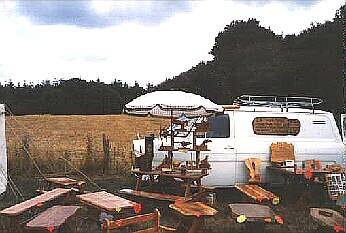
"I decided to?work from Monday to Friday making?the?garden benches, coffee tables?etc,?under?my?make shift shelter?and on the Friday evening?before setting off home I?would load up the van for an early start the following morning. We would the drive into the country side and try and find a suitable?lay-by alongside a main road to?'set up shop' for the day.?Fortunately with all the passing traffic this often proved quite successful in?re-generating?sales?and orders for my furniture ".?
Whilst?waiting for?customers to appear?Ian?could?often?be?found sitting inside the van?carving?the animals and birds?from any old pieces of wood he could find.. Eventually when he had completed a few carvings and?slowly began to gain a little?confidence in his new found skills as a woodcarver he?agreed to his wife's? repeated requests to display these woodcarvings amongst the coffee tables and garden furniture.
A larger order was then received to?completely fit out?a new 'Wine Bar'?with all the wooden?tables, chairs, benches, bar stools, garden furniture, bar top and even carving the sign for the Wine Bar. This?order?soon enabled me?to?move into new premises?not to far away from my old workshop. I?could also now?start to try and replaced?a lot of the lost tools and wood working machinery destroyed?in the fire, including one of my first purchases?a good second-hand?planning machine.
?
Ian eventually moved away from the various lay-by's?and started exhibiting?his furniture along?with his woodcarvings?in Country Fairs and Shows throughout Southern England. This?fortunately proved to be quite successful, at least customers could still?see examples of my work without having to?visit the?workshop. "However these?new found skills as a woodcarver had started to take up much more of? my time and interest.?It was then the local press, Television and Radio, who?fortunately?rather liked the 'Phoenix from the Ashes' type story and?how I first got involved with carving. This media interest started?to?generate a large amount of? free publicity which?helped considerably in?receiving?new commissions for my woodcarvings. I?soon?started?to get? far more inquires for my carvings than for my furniture, so although I had?now rebuild the business my interest in making furniture had begun?to second place to my woodcarvings so I decided to?let the? furniture making side of my business run down naturally and to try to?concentrate all my efforts?on?making a potential new career as a woodcarver."
"It was tough going over the next two years,?I sold some of the wood sculptures?and just survived. Being self-taught meant I had to learn from my mistakes and consequently I soon learnt a lot, but as I have always spent my life?working?on the premise ‘ if all else fails, read the instructions, I felt I was quite well equipped to cope,?I certainly hoped so".? A local newspaper ran a full feature about Ian's work which was?spotted by a Gallery owner visiting friends in the area who?asked to see his work and consequently invited him to exhibit his?wood sculptures in a top gallery in Mayfair,?London for a pre-Christmas showing, Ian's?first exhibition in an Art?Gallery. This?exhibition fortunately?generated?a lot of?interest?and?was extended for a further six months.". " Further exhibitions in various art galleries and a few years later was?invited by the Hampshire Museum Service to have a?six month touring exhibitions of?his?Sculptures in?a variety of?Museums across the county all of which really helped?to get Ian establish in the Art World.
"Woodcarving can and often is?a rather slow process just using hand chisels and a mallet, although Ian initially starts work on a large sculpture with a chainsaw?to remove as quickly as possible the larger sections of wood, it still?often takes?quite some time?to produce?a large sculpture,? therefore?collect together a good exhibition?of wood sculptures which can?show all the various aspects of my work?takes?time and therefore money to build up." Although working on commissions was?and still is?where most of my time is?spent,?in the early day it did?prevent me?from?getting?a large collection of different sculptures together for such exhibitions. The only way forward was now to try and reduce?the amount of commissions I undertook?and try to concentrate spending more time on building up some special exhibition pieces.?
"This idea of no longer making?the time available to produce?furniture, cutting down on my commissions and consequently?having little income? unfortunately, eventually began?to use up the patience of my latest?bank manager, so?the search was on yet again to try and find?another Bank who would help out. Fortunately, before to long I?found?a new bank manager from the Royal Bank of Scotland , who agreed to?allow?me the time?and resources to work on producing?a large collection?of wood sculptures for a major exhibition which had been?planned?the following year in London ."
On occasions?during this period,?it was sometimes still? necessary to use?some of the remaining?supply of??seasoned timber and quickly make?some garden furniture?to sell and try?to make ends meet.?As the Transit van was?sold many months earlier?to raise some money, my car an old Triumph Stag was quickly pressed into service for a few months to take over the deliveries of? these occasional items of furniture, until this Stag?also had to be sold?to help?raise some much needed cash.?
It took almost eighteen months of working?long hours, with no holidays or days off?before he?finally?managed to put together this?large and varied collection of?wood sculptures. These sculptures were?again mostly?of wildlife studies?with many?being?life size,?these included a?pair of swimming otters, a running cheetah, a sleeping lioness, an Owl in a log?and?a pair of golden eagles, one of which was in full?flight, all beautifully carved in?very fine detail from Walnut, Tulip, Cedar, Willow?and Lime wood.?
With just?two weeks to go before the all-important exhibition in London?this large and varied collection of sculptures were?finally completed.?Ian was then?asked by a friend if he would be prepared to?loan?these?sculptures?for?her newly opened Art gallery in Bournemouth during?the first week of?a special?exhibition she was planning, just before he?took all the?sculptures?to London. Something?Ian?was only to?pleased to help out with.? She thought the sculptures would be a nice contrast to the wildlife paintings she had on exhibition,?also hoped it might?help her with generating?some extra publicity?for the?Gallery.
"The exhibition certainly did manage to generated a lot of Media attention, however not in the way?either of us?had hoped for. During the early hours of the morning the day?before the exhibition was due to open, thieves smashed down?the heavy plate glass?of the art gallery, broke in attempted to steal?Ian's?sculptures. Some of those wood sculptures not stolen?were?damaged when the?galleries?heavy plate glass?windows shattered and fell down and into the gallery on top of them.
?
 ???
???
?
Unfortunately?the vast majority?of the collection he had worked so hard on producing had?now been either?stolen or were?damaged.?The police who were on the scene very quickly?were excellent and managed to eventually recover some of the?sculptures a few weeks later, however?it proved to be?too late for the exhibition in?London?which?had to be cancelled, unfortunately the London gallery although?sympathetic were?quite understandably none to pleased, this was to put?back Ian's plans on a further major exhibition in London again for?a quite a few?years to come.
?
?
"Up to this stage?The size of the wood sculptures I produced were limited by the size of the trees I could find and obviously afford ?. Also the largest of these trees I had hoped to develop my?skills on would have had preservation orders on them which prevented them from being felled anyway. However fate was again to lend a helping hand, in October 1987 Southern England was hit by Hurricane force winds, which uprooted millions of trees. Overnight I had been given a large supply of massive trees, many of which were donated free of charge by the local councils 'if I?got them of the road'.??With help from?a friend and?by hiring a?lorry with a?crane this task of? hauling away the best of these fallen trees kept me?very busy for weeks,?once they were?all stored away for?seasoning,?the timber was?to last me?for many?years to come."?????
?
?
?
?
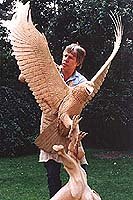
?Bald eagle carved from one piece from within the fork of a Lime tree:?- please?click to enlarge?
The first of these larger sculptures Ian started to experiment on,?carved from one of these huge fallen trees was a 10 feet high Life size Bald Eagle in flight carved in one?piece from within the fork of a 150 year old lime tree.( shown above ) ?This sculpture was?initially shaped with a chainsaw?where it had fallen?as it was far to?heavy to be move as it was?to far away from the nearest road,?the tree having fell?on?the side of a hill?didn't help much either. Ian spent the first?week working on the sculpture during?a freezing cold and wet January, trying to?reduce as much of the weight as possible?so he?could eventually carry?the massive roughed out?eagle sculpture back to the comfort of his?studio for finishing off.??
“ I?built up a picture in my mind what the particular sculpture?should eventually look like, obviously?the overall design of the carving is?restricted within the parameters?of the log, however?I tend to try and adjust?the particular pose?the sculpture should take as I go along, not only to try and give the sculpture a more flowing movement but also to enable me the freedom to re-position the carving within the log?if a flaw in the wood suddenly appears deep down in the wood?or,?as is sometimes the case you suddenly find a piece of rusting metal from some long lost fencing?or washing line hiding in the wood. Usually the first clues of this obstruction is?the rather?pretty shower of sparks you see as the hidden metal?object quickly strips away the sharpened teeth of?your chainsaw
"Carving anything from a single piece of wood let alone a 10 feet high eagle in flight, especially?as I had not done anything quite like it before?takes a lot of concentrated effort, one mistake and a potential vital?part of the sculpture could?be?lost. It eventually took?several months?work in my studio before the carving was?finally complete in all its fine detail, fortunately without any?feathers missing. The?eagle was then?bleached and stained to give a more true to life Bald eagle appearance."
Birds of Prey sculptures, particularly eagles are Ian’s favourite subjects to work on and are produced extremely realistically especially when they are carved life size, attention to detail is rather extraordinary especially?to the flight feathers which can take hours to carve almost paper-thin,?patience is?essential as there are obviously hundreds of feathers on each bird sculpture. To relive boredom during this stage he always tends to work on completely different style of carving?at the same time.
"As well as a few setbacks I have also had?some rather lucky breaks which tends to even things out quite a bit." One of these lucky breaks was when?the London Times newspaper?ran a feature about Ian's work?which was also appearing in a London gallery. A?member of the Royal Household saw his?work and?was so impressed by the standard of? Ian’s carvings he was invited?to London to discus a variety of unique commissions for Henry V11 Chapel in Westminster Abbey and St George’s Chapel in Windsor Castle, two of the most historical and widely visited buildings in England.
From that moment he never looked back,?within five years from the fire Ian was appointed ‘Sculptor to?the Most Noble Order of the Garter and Honourable Order of the Bath’ and now spends around three?months of each year on a large and variety of?commissions for?the?British Royal Household. These commissions? not only included producing the?painted and gilded?Crowns, Coronets and Crests?for the latest Knights of the Garter and Bath, but various other sculptures using?both wood and bronze for?the Royal Household..?" One?aspect of? his?work I particularly enjoy is the regular invitation I?receives to?Windsor Castle and Westminster Abbey to attend?these historic ceremonies and?to?be involved in my own small way, part?of? a?tradition?that has?been going on for many Centuries."
?
Ian delivering his completed Coronet for HRH The Princess Royal -?HM The Queen at the Order of the Garter Service at Windsor Castle
It takes Ian?two to three weeks to carve each particular crown, crest or coronet in his studio, working from the beautifully painted one-dimensional water-colour designs he is presented with, which he then transforms?into an impressive three-dimensional Limewood?wood carving designed to last for?centuries.
“One of the main criteria I was given by the member of the Royal Household when I was first asked to produce this work, was that ' the commissions will all be totally different so I must be capable of carving anything' a?rather?daunting prospect?at the time I recall, as I had only been carving for a few years". Also?an added pressure was the sculptures obviously had to be carved to?the very highest standard but also and had to be completed and delivered on time, as these Crowns, Coronets and Crests?were an integral part of the State Ceremonies held at Windsor Castle and Westminster Abbey". Fortunately Ian has risen to the task?over the past fifteen?years, although his?ability?has certainly been well tested as each one of these commissions to date from the Royal Household are indeed all totally unique.
?The first of these sculptures for the Order of the Garter was to be the carved and gilded Crown for HM Juan Carlos I of Spain to be placed in St George's Chapel Windsor Castle this commission was quickly followed by a carved and painted life size Heraldic sculpture of a Cockerel for an?Admiral of the Fleet for the Order of the Bath which was then placed in Henry V11 Chapel in Westminster Abbey. These first two commissioned were delivered to London during the middle of the summer, fifteen years later over seventy commissions have so far been received from the Royal Household. One of the more recently commissioned carvings he?produced?for a recently installed Knight of the Garter was a ‘Phoenix rising from the flames’,?quite ironic really considering how Ian first started carving.? ???????????????????????????????????????????????????????
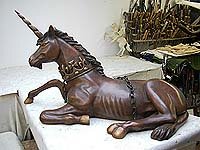
?These?commissions for the Royal Household are often as varied as?carving, Regal Lions to Mythical Unicorns and State?Crowns and?Coronets for Royalty and the Nobility from all over the World. Carvings?also range?from Majestic Eagles,?to Busts of Men and Woman?for Field?Marshals, Admirals of?the Fleet and Marshals of the Royal Air Force.?These designs also include other Animals, Birds and?Flowers for Prime Minister and other Heads of State,?more recently these?? commissions have included producing the 20 inches high carved and gilded Chrysanthemum Crest for His Imperial Majesty Emperor Akahito of Japan.????????
On?23rd of April?each year on St George’s Day, Buckingham Palace officially announce who is to be the latest recipient of the Most Noble Order of the Garter,? the highest honour the Sovereign can bestow. A few weeks later?Ian receive?the detailed coloured drawings to work from.?These carvings for the Knights of the Garter are then required to be completed in time for the annual Garter service?held at St George’s Chapel?Windsor?Castle in June the following year.???? ????????????????????
Fortunately these sculptures are usually spaced out quite evenly over the year enabling Ian to work on his other?private and commercial commissions, however during HM The Queens Golden Jubilee year in 2002, fourteen commissions were received from the Royal Household all within weeks of each other?which kept him extremely?busy as they all had to be completed and installed in time for both these historic services in?Windsor Castle and Westminster Abbey.???
?
?
A small selection of?over?sixty,?Crowns, Coronets and Crests that have?been carved?and painted by Ian G Brennan, before they were placed in St George's Chapel Windsor?and?Henry V11 Chapel in Westminster Abbey for the?Knights of the Most Noble Order of the Garter and Most Honourable Order of the Bath.??
?top row ?- ?Lavinia,?Duchess of Norfolk - HM King Juan Carlos1 of Spain - Baroness Margaret Thatches -?Lady's and Knights?of the Order of the Garter
?? bottom row ?-??????Lord Beetham? -??Sir Frank Cooper - Sir Henry Leach? -? Knights of the Order of the Bath.
?
These?carvings produced by Ian during HM the Queen's?Jubilee year included a sculpture of an?Ostrich, Bobcat, Cornish chough bird and a?Boar again all carved from lime wood, painted and then gilded for the Knights of the Bath. Commissioned for the latest Knights of the Garter was a Phoenix rising from the Tower of London, a?Hawk standing on a gauntlet?and the carved and gilded Crown for HM King Harald V of Norway,?
Over the years Ian has?also worked on a large variety of more realistic?commissions, which has been as?varied as producing?a life size bronze 'Osprey catching a Pike' for a fountain, a life size statue woodcarving of the 'Risen Christ' for a local church, to carving a replica of a life size lion figurehead for a Museum in Portsmouth?and?then spending several months working on board 'Lord Nelson’s?flagship’ HMS Victory' carving all the intricate replacement?scrollwork which surrounds?the starboard side entrance port on the middle gun-deck on this 104 cannon First Rate Warship, which was originally built?in 1765.????
???
HMS Victory was?Admiral Lord Nelson's Flagship at the Battle of Trafalgar and is the oldest commissioned?Warship in the World. During?1989/90 Ian was invited by?The Royal Naval Dockyard in Portsmouth in Hampshire UK to carve?from huge solid blocks of? mahogany an exact replica of the?original Starboard Side Entrance Port on?this historic?warship HMS Victory, who's restoration is near completed..?
?
?
?Admiral Lord Nelson’s Flagship HMS Victory with the replacement scrollwork carving
?
Other?restoration projects Ian has?also?been involved with include?more recently working in? 'Southwick House' at HMS Dryad, which was?General Eisenhower's Allied Headquarters in Southern England for 'Operation Overlord ' during WWII?(where D Day was planned). During the recent restoration of this historic building Ian was commissioned to repaired and?replace all the missing finely carved mouldings and detailed woodcarvings on the huge antique mirrors and picture frames? which have hung on the walls in this magnificent mansion?for centuries.
Although Ian?started using wood as a medium for his sculptures in 1984, enjoying the challenge of carving from a single solid block,?a moments carelessness a few years ago with a?chainsaw and a subsequent serious injury to the tendons in his left hand prevented him from holding carving chisels and therefore working for almost eight months. Fortunately however?the exceptional skill of the surgeons and staff?in the local hospital eventually repaired the damage. Ian?then had to attend the hospital?three days a week for physiotherapy?treatment throughout?this period?in an attempt?to fully regain?movement in his hand,?part of his?treatment after physiotherapy?was also to be spent in the?occupational therapy unit workshop which was attached to the hospital.
Amongst?the equipment?in this?workshop?at the unit was a?wood turning lathe something?he had never used before, the subsequent?lessons given by a?member of staff at the hospital?showing him how to use?this lathe?proved most useful, not only in helping him to get the flexibility back into his hand which is the prime purpose of the machines at the unit, but also?learning how to make?with the lathe potentially wooden crowns and coronets?for the future. These crowns were?made from the blank pieces of lime wood Ian?started take with him into the hospital therapy unit most mornings. "I originally used to carve all the crowns and coronets by hand, but to suddenly now to have a wood turning lathe and an expert?to show me how to use it properly whilst I was undergoing treatment was too good an?opportunity to miss.??
?
“I am afraid however I soon?discovered, as also did?the staff and fellow patience in the unit that not all woodcarvers make?good wood turners.? "As much as the instructor tried to show me the correct way to use the lathe, after a while I would as often as not just for a moment loose concentration and return to my old carving?ways and try?to plunge the chisel in the spinning block of wood far too deep, with often rather unfortunate?consequences,?a terrible bang was quickly followed by frequently damaged?pieces?of?wood or?the occasional?broken chisels.
Eventually Ian's wood turning skills?gradually started to improve and over the weeks and months that followed,?these blank blocks?of lime wood which he took with him each morning to the hospital unit,?built up to a rather large collection of?wood?turned to the rough shape of?Crowns and Coronets for future potential commissions for both Windsor Castle and Westminster Abbey
Over the years various Art galleries particularly those in London had suggested?perhaps Ian might consider producing some bronze sculptures to exhibit alongside his woodcarvings as?the contrast between?wood and bronze?would be rather effective?in?future exhibitions. Although the though had a curtain amount of appeal to Ian, he was so busy producing his woodcarvings the idea?of stopping his rather hectic carving schedule?to?experiment with a totally different medium?did not really appeal to him to much.
The technique and tools required for?woodcarving is also?total different to that required in producing bronze sculptures.?In woodcarving you frequently start with a solid?block of wood and slowly remove everything that is not required for the particular sculpture obviously?taking care not to remove something you shouldn't until you accomplish the desired result. With bronze sculpture you start with nothing but pieces of clay, wax or plaster?and slowly add the material together to eventually create the sculpture you are after?and if you were to make a mistake you can simple add another piece of material on.
?
The accident to Ian's hand however?changed everything he had no choice but to follow the Doctors orders and to stop woodcarving and try and?work in a much softer more malleable material which was more suitable for his?situation.?This way of working?also helped Ian?to regain?full movement?back into his hand. The first of Ian's bronze sculptures was a small 'Elephant and Calf' made from clay which could easily be worked with one hand.
?
Ian's?original clay sculpture alongside the?bronze version
10 inches?(24cm) long
?
Ian was told by the doctors that although the injury to his tendons were?healing well he?must still not try and work again holding carving chisels with that hand for several more?months. "As any savings we had?gone the possibility of?having these clay elephants produced in bronze were rather slim.?It is?a rather expensive process?having the sculpture 'master copies'?moulded and then cast in bronze, It?therefore seemed rather pointless tying to build up a collection of clay sculptures only for them to be left to eventually?dry out and crack in the corner of the studio".
?
Shortly after?Ian's accident?friends of his Terry and Judy Elson, who over the years had purchase a number of Ian's larger wood sculptures arrived unexpected to see what he was working?on. Ian explained he was unable to carve at the moment and how he would now like to try and also work in?bronze. Terry jokingly said when they?win the Lottery they would pay to have?all?Ian's wood sculptures?they owned and the other?sculptures Ian?still had in his studio, moulded and cast in bronze.
A few week later Terry and Judy?again turned up to?Ian's studio and explained to his total amazement they had indeed just won the lottery and true to his?word they confirmed they now would have some of Ian's sculptures moulded and produced in bronze. The following day the first?of these potential? wood sculptures were taken to the 'Phoenix' foundry in Southern England and over the next few months moulds were produced?of?Ian's?original wildlife wood carvings which would eventually enable a number of editions to be produced from each of the moulds..??
?

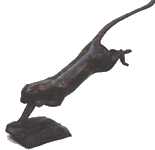
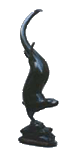
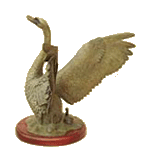
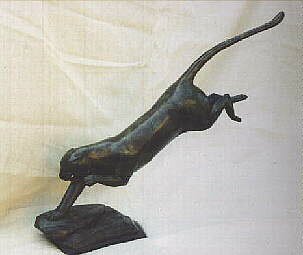
Osprey catching a Pike? -? Leaping Panther? -? Swimming Otter? -? Swan with Cygnets
66" high x 39" wide??? ?-???? 45" Long ?x 37" High????? -??? 43" high x 17" wide?? -?????27" high x??34" wide
?
?
All?four?bronze sculptures?were originally carved from?a single piece of?English walnut or lime wood, moulded and then cast in bronze.
?
?
These sculptures?included?life size swimming otters,?a?'mute swan and cygnets', a large leaping panthers',?a?leopard sleeping in a tree and?a?pair of golden eagles'. Even the life size sculpture Ian was working on when he had his accident, the life size osprey catching a pike was to be moulded and cast in bronze. One day Ian was building?a reputation with his highly detailed?wildlife woodcarvings, a few months late he was able to?built up an equally impressive large collection of bronze?wildlife sculptures.?
Although?initially those?bronze sculptures were?examples of ?wildlife and birds of prey sculptures . Future?commissions now also include realistic sculptures of the human form, with a recent commission of an eight feet high realistic sculpture?of?'Ted Bates' the former player, manager and president of Southampton Football Club. This statue once completed will stand outside the Football Clubs new stadium.
When appropriate Ian still?produces the master copy for his latest bronze sculptures in wood, which is then carefully moulded to produce the bronze sculpture. This highly detailed ‘master copy’ woodcarving can?then cleaned up, polished and?retained as a unique sculpture, unlike the normal method of producing a bronze sculpture which usually means?the master copy being made from clay or wax, is often cut up and then discarded?during the moulding process at the foundry.? https://sculptor-iangb.com/creating.html )
??????????????????????????
?Leaping Panther carved from Walnut, cast in?Bronze
?
Ian often works on a number of different commissions at the same time, which enables him to go from one to another throughout the week working on each one completely afresh. " The total?contrast between perhaps one day working on a life size wax sculpture of a swimming otter for a bronze to then perhaps carving a jewel encrusted Crown for a Queen,"?is what makes his?work so enjoyable?. His commissions have also often been as diverse as carving an ten feet high Bald Eagle for an American Corporation, to a life size statue of the Risen Christ for a local church, a five feet high?Lion Figure head for a Museum, to then carving from elm wood a 2 feet high gilded tooth which was to placed outside a Dental Surgery near Southampton.
????????????????????????????????????????????????????????????
?
????????????????????????????????????? The six feet high Osprey catching a Pike Bronze - the Risen Christ statue and the 'gold tooth'?? ????????????????????????????????????
It is quite understandable why Ian particularly enjoys producing his wildlife sculptures, when wild Badgers, Foxes, Squirrels and Deer are regular visitors to his studio often whilst he is working, on occasions they also bring their young with them who can then be found running around his studio. These visits also gives Ian the rather unique opportunity of studying the wildlife close at hand which is often the subject of his sculptures, the studio being built at the edge of woodlands in a nature reserve.
???????????????????????????? ????????????????????????????????????????
?
Various wildlife both inside and outside?Ian's studio
Although Ian's?furniture making days are long gone the old skills learnt are?occasionally?still put to good use, as?he?was commissioned to make the Pascal candle-stand for St George’s Chapel in Windsor Castle. Made from oak and designed to suit the?splendour of this Medieval Chapel, the carved and gilded oak Pascal candle-stand was completed in time to be lit in a special ceremony by HM?the Queen during the annual Easter service, before?it was placed in front of the High Altar?in Windsor Castle.? ?
The Pascal Candle Stand commissioned for the High Alter in St George's Chapel Windsor Castle .
carved and gilded?Oak -?65 inches high?
?????????????????????
Ian's?most?recent?carved and gilded Crown?to be placed?into? St George's Chapel in? Windsor Castle was?for HM King Harald V of Norway . In March 2004 Ian delivered to Windsor Castle the four latest?commissions produced?for the Royal Household,?these include?the?a carved and gilded?Coronet for HM the Queen's first cousin, HRH Princess Alexandra, a sculpture?of a?Hound,?a carved Badger?and a?sculpture of a Black Bull, all of which were placed in St George's Chapel in Windsor.
HM The Queen's daughter,?The Princess Royal taking an interest in the relief woodcarving?of the village of?Warsash in Hampshire UK which was recently?placed above the Vestry in St Mary's Church Warsash.?
?( lime wood 10?feet wide )????????????
?
?
?
Ian G Brennan was recently invited to Windsor Castle to give a?talk?about the various aspects of his work as a sculptor. This?talk was not only about the wide variety of?sculptures he?has produced for the?past seventeen years for the Royal Household, but also?how he first became a sculptor.?Although many members of the audience?in St George's Chapel were aware Ian had created?over thirty?sculptures for the Choir of the Chapel, but very few were aware of how his career as sculptor?first started.
?
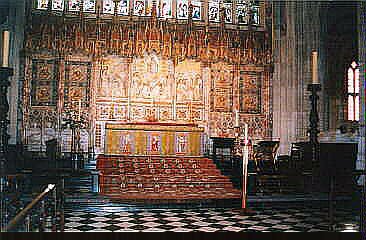
Ian's talk?began with?how he first discovered?his by then unknown ability to carve?after? his?business?was totally?destroyed in a fire. The informal talk?which took place?in the nave of? St George's Chapel,?which is not only one?of the most revered hallowed Royal shrines of the British Monarchy, but also one of the most beautiful buildings of its kind in the world,?rich in history and a place of prayer.?Directly behind Ian?in the Chapel as he was giving his talk was a?beautifully?fabric frontal?which covered the Alter, richly?embroidery with?a Phoenix?rising from the Ashes; The date?of Ian's talk also happened to be?May 7,?exactly 21 years to the very day of the devastating fire; Ian had?come of age.
?
?
Click image to enlarge
?
?
??The Phoenix Alter Frontal in St George's Chapel
?
?
It is?said to some success?comes easily,?to others?they have to work hard for it, but to Ian?it came as?such a great surprise. No one?especially Ian would have thought? that?a fire which?totally destroyed his?business?would at the same?time release his dormant?and?then unknown natural ability?to be a sculptor, all?quickly followed?by?many unusual?and unexpected twists and turns and not forgetting?lucky breaks. So if you also then add?a great deal of?determination with?an amazing?natural ability to?be able to teach himself to carve and cast in?a variety of?different mediums.?Ian has now managed to achieved things which he never realised he was ever capable off.
?
??????????????????????????????????????????????????????????????????????
?
?
?

?
Copyright © 2007 all rights reserved
?
???
Return to Artist Information